
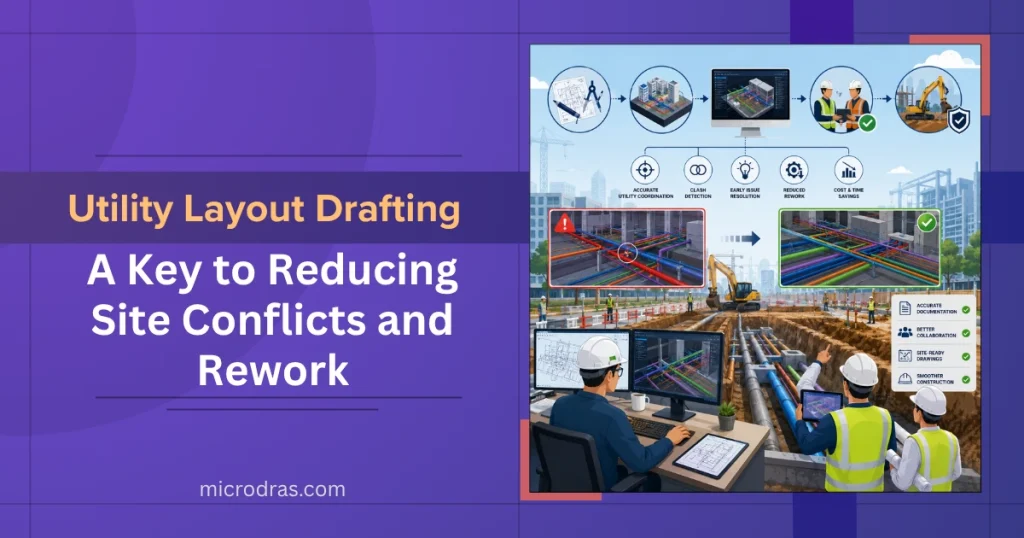
A trench is the most expensive place to discover a drafting mistake.
Utility layout drafting maps where water, sewer, storm drainage, power, and telecom lines run beneath a site before a single trench is dug. When these lines are drafted with precision, contractors know exactly where to dig, where not to dig, and how new utilities tie into existing infrastructure. Projects that skip this step, or rely on outdated reference drawings, often discover conflicts only after equipment is already on site. A properly coordinated Combined Services Drawing brings every utility trade onto one sheet, eliminating the guesswork that causes expensive rework.
The cost of getting utility coordination wrong rarely shows up during design. It shows up weeks later, when a backhoe strikes an unmarked line, when a sewer invert does not match the grading plan, or when two trades route through the same trench corridor. Professional drafting catches these issues on paper, where fixing a conflict costs nothing more than redrawing a line. Once construction starts, the same conflict can stop a crew for days, trigger a change order, and push every downstream trade behind schedule. The earlier a clash surfaces, the cheaper and faster it is to resolve — which is the entire argument for drafting the utility layout properly before the first shovel touches the ground.
What Does Utility Layout Drafting Actually Involve?
A complete utility layout shows horizontal and vertical positioning for every underground service: water mains, sanitary sewer, storm drainage, gas lines, electrical conduit, and telecom ducting. Drafters cross-reference civil grading plans, architectural footprints, and utility provider records to confirm clearances, depths, and crossing points before anything is finalized.
The goal is a single, layered drawing that every trade and inspector can read the same way. Without that cross-referencing, utility runs are often drafted in isolation, with each trade assuming the corridor underground belongs to them alone — exactly the assumption that produces clashes once excavation begins. A coordinated layout removes that assumption entirely by forcing every service to be checked against every other service on the same sheet, at the same scale, before a single permit is filed or a single trench is marked.
The Numbers Behind Coordinated Utility Drafting
Coordinated utility drafting consistently reduces the number of conflicts discovered once trenching begins, since clearances and crossings are checked against every other service before construction starts. That single review step removes entire categories of field surprises that otherwise surface only when a crew is already standing in an open trench with equipment idling.
Projects also move faster overall. Permitting authorities and utility providers can review one clear, coordinated layout instead of piecing together separate trade drawings, which shortens approval cycles and keeps the schedule intact from groundbreaking through substantial completion. Fewer review rounds also mean fewer opportunities for a missed clearance to slip through unnoticed.

Uncoordinated vs. Professionally Drafted Utility Layouts
Manual or Isolated Utility Plans
Drafted Utility Layout Plan
The difference is not the complexity of the project. It is whether conflicts get caught on a drawing sheet or inside an open trench, where every fix costs labor, materials, and schedule time that a coordinated layout would have avoided entirely.
Where Utility Layout Drafting Makes the Biggest Difference
What to Check Before Finalizing a Utility Layout
“A utility conflict found on paper costs an eraser. The same conflict found in a trench costs a schedule.”
Plan the Trench Before You Dig It
Utility layout drafting is the step that decides whether a site moves smoothly from permitting to substantial completion, or stalls every time a crew hits something unexpected underground. The drawing itself is inexpensive. The conflicts it prevents are not. Every clash caught on a coordinated sheet is a delay, a change order, and a difficult phone call that never has to happen.
If your current utility drawings are still siloed by trade, or based on records that predate the last site change, it is worth a closer look before you break ground. Contact us to discuss your site and get a coordinated utility layout built around how your project actually gets built.
Frequently Asked Questions
What is included in a utility layout drafting package?
Can utility layouts be created from existing site records?
How does utility drafting reduce rework on site?
Do you coordinate utility layouts with other MEP trades?
How long does a utility layout typically take to draft?
Plan Your Site’s Utilities With Confidence
Get a coordinated utility layout drafted around your actual site conditions — not assumptions.

