
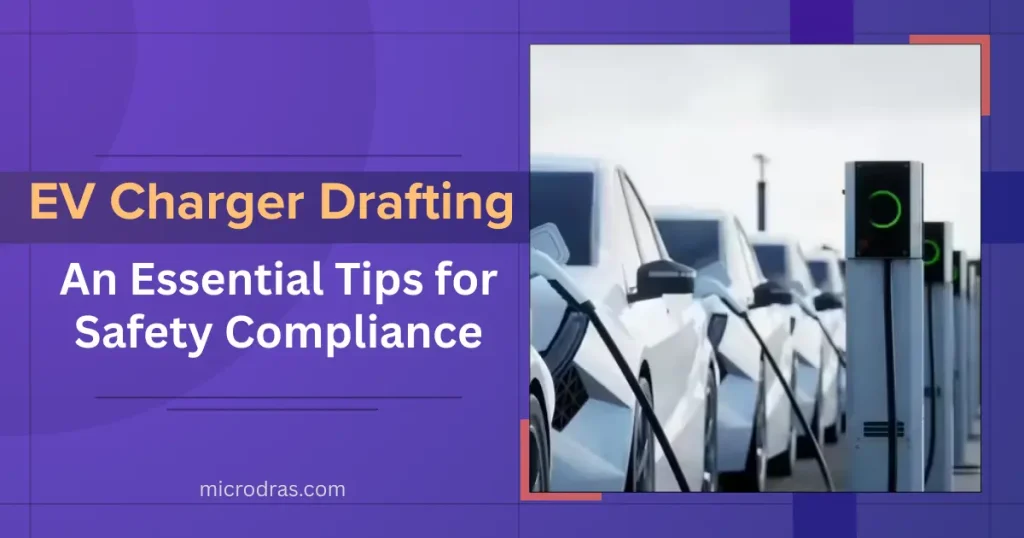
Electric vehicle charging infrastructure represents one of the fastest-growing sectors in modern construction, yet it carries unique electrical hazards that demand exceptional documentation accuracy. Unlike traditional electrical installations, EV charging systems deliver sustained high-power loads directly to public-accessible equipment—making precision drafting not just a technical requirement but a life-safety imperative.
The High-Stakes Nature of EV Charging
EV charging stations operate at significantly higher power levels than typical electrical outlets. Level 2 chargers draw 7.2-19.2 kW continuously, while DC fast chargers can demand 50-350 kW or more. This sustained high-amperage flow creates thermal stress, voltage drop challenges, and fault current scenarios that require meticulous engineering documentation to ensure safe, reliable operation.
Cable Sizing Precision Prevents Fire Hazards
Undersized conductors in EV installations create dangerous heating conditions that traditional circuit protection may not detect immediately. Precision cable-sizing calculations documented in professional EV charger drawings account for ambient temperature, conduit fill, duty cycle, and voltage-drop limitations that generic templates ignore.
Incorrect wire gauge selection has caused multiple documented EV station fires, resulting in property damage, injuries, and complete station shutdowns. Detailed cable routing drawings ensure proper conductor sizing at every segment, preventing thermal buildup that can lead to insulation failure and arc faults
Load Calculation Accuracy Ensures System Stability
Multi-port charging stations require sophisticated load management strategies to prevent transformer overload and service panel failures. Professional load calculations documented in electrical drawings determine proper transformer sizing, panel capacity requirements, and load-sharing protocols that allow multiple vehicles to charge simultaneously without system failure.
Improper load analysis causes breaker nuisance tripping, reduced charging speeds, and premature equipment failure—problems that only emerge after expensive installation completion when corrections cost 5-10 times the original installation price.
Electrical Safety Through Documentation Excellence
Grounding and Bonding Precision
EV charging equipment exposed to public access and outdoor conditions requires fault-current-rated grounding systems that protect users from electric shock hazards. Precise grounding drawings specify ground-rod placement, bonding-conductor sizing, and equipment grounding paths to ensure fault currents return safely to the source without creating dangerous voltages on accessible surfaces.
Ground fault protection for EV equipment must respond within milliseconds to prevent lethal shock conditions. This requires properly coordinated protective devices, documented through detailed single-line diagrams that show device ratings, settings, and coordination curves.

Clearance Standards Prevent Access Hazards
ADA compliance and electrical clearance requirements demand precise dimensional accuracy in layout drawings. Parking space dimensions, charger placement heights, and equipment clearances must meet multiple overlapping codes, including NEC Article 625, the ADA Standards, and local parking regulations.
Improper clearances create vehicle collision risks, accessibility violations, and maintenance safety hazards, triggering legal liability and operational shutdowns. Professional layout drawings verify compliance with all applicable standards before construction begins.
Permit Approval and Utility Coordination
Utility companies and electrical inspectors immediately reject incomplete or inaccurate EV charger documentation. Missing load calculations, unclear grounding details, or ambiguous cable routing cause permit delays that extend for months while drawings undergo revision cycles.
Professional EV charger drawings include comprehensive details that proactively address inspector concerns: voltage drop calculations, protective device coordination, emergency disconnect locations, and equipment clearance verification. This documentation completeness accelerates approval processes and prevents costly construction delays.
The Cost of Documentation Shortcuts
Projects that skimp on professional drafting invariably experience cost overruns exceeding the drafting investment by factors of 10-20 times. Installation errors requiring conductor replacement, panel upgrades, or equipment repositioning consume weeks of schedule and tens of thousands of dollars in corrective work.
Safety incidents resulting from poor documentation create catastrophic liability exposure that can destroy businesses and end careers. The investment in precision drafting provides insurance against these devastating outcomes.
Professional Standards as Project Foundation
Successful EV charging infrastructure begins with electrical drawings that combine technical precision, code-compliance expertise, and real-world installation experience. This requires specialized knowledge of EV-specific standards, utility requirements, and emerging technologies that generic electrical drafting cannot provide.
Don't let poor documentation create safety hazards and project failures!
Get precision EV charger drawings with accurate cable sizing, compliant grounding details, and permit-ready documentation. Contact our EV design specialists for a free consultation and discover how professional drafting protects lives, investments, and project success.
Don’t let inadequate drawings compromise the safety and success of your EV charging project!
Microdras delivers precision EV charger design documentation, including accurate load calculations, compliant electrical layouts, and safety-focused detailing, ensuring permit approval, efficient installation, and long-term safe operation for projects worldwide.


